
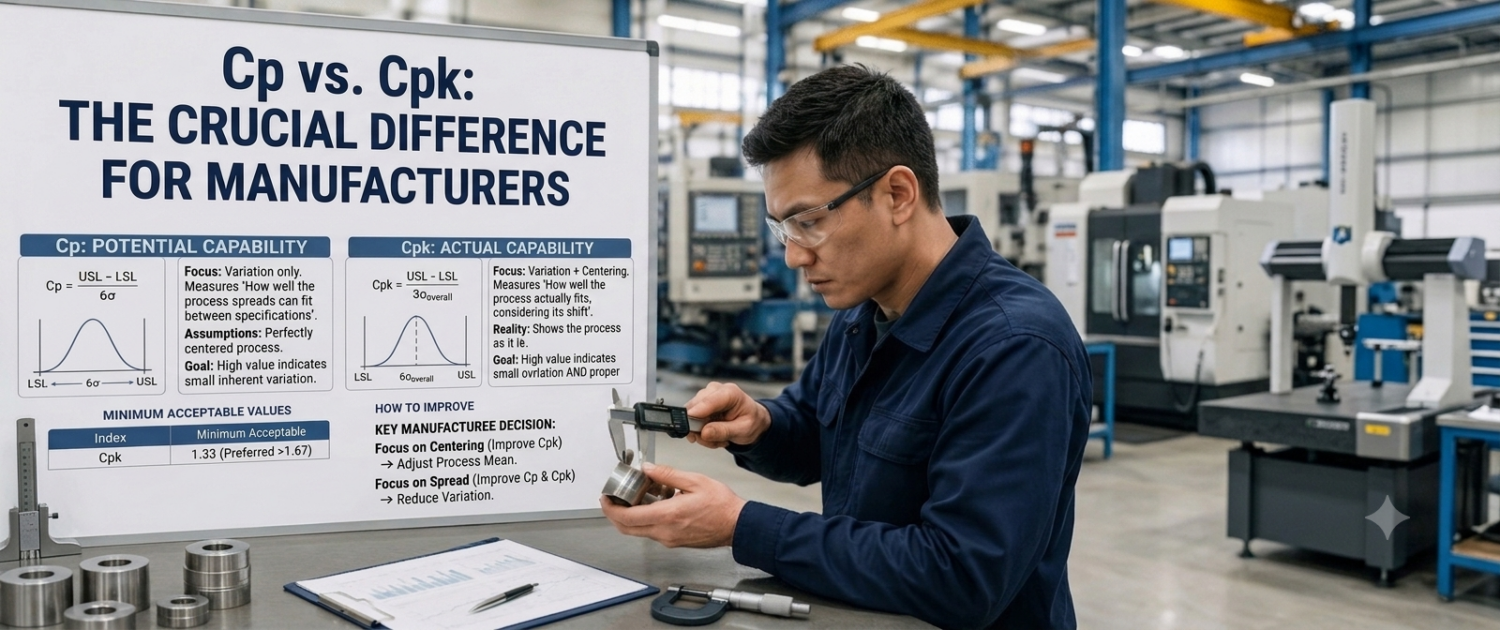
CP and CPK are both statistical measures of how well a manufacturing process can produce parts within a customer’s specification limits — but CP measures a process’s potential capability assuming it’s perfectly centered, while CPK measures its actual capability, accounting for how far the process is really centered within those limits. In practice, this difference is exactly why two processes with the same CP value can produce very different real-world defect rates.
If you supply parts to automotive or engineering OEMs, you’ve probably seen both terms on a quality report and treated them as roughly interchangeable. They’re not — and the gap between them is often where hidden quality problems live.
First, What Are We Actually Measuring?
Before comparing CP and CPK, it helps to be clear on what “process capability” even means.
Every manufacturing process has natural variation — no machine cuts, molds, or casts a part exactly the same way every single time. Process capability studies measure that variation and compare it against the customer’s specification limits (the upper and lower bounds a part must fall within to be acceptable).
The question process capability tries to answer is simple: can this process reliably make parts within spec, or is it going to produce defects even when everything is running normally?
CP and CPK are two different ways of answering that question — and they don’t always agree.
CP: Potential Capability
CP looks at the width of your process variation compared to the width of the specification limits. It answers: “If this process were perfectly centered between the upper and lower spec limits, could it fit within them?”
Here’s the catch: CP doesn’t care whether the process is actually centered. It only compares the spread of your process to the spread allowed by the spec. A process could have an excellent CP value on paper while still producing defective parts — because CP simply doesn’t account for the process drifting off-center.
Think of it like asking “is this parking spot wide enough for my car?” without checking whether the car is actually parked in the middle of the spot. The spot being wide enough doesn’t help if the car is parked crooked and hanging over the line.
CPK: Actual Capability
CPK takes the same variation data but also factors in how centered the process actually is within the spec limits. It answers a more honest question: “Given where this process is actually running, right now, how likely is it to produce parts within spec?”
Because CPK accounts for centering, it will always be equal to or lower than CP for the same process. If CP and CPK are close together, the process is well-centered. If there’s a big gap between them, the process has plenty of potential capability but is running off-center — meaning it’s likely producing more defects than the CP number alone would suggest.
This is exactly why relying on CP alone can be misleading. A high CP with a low CPK is a process that looks fine on one number and is quietly producing scrap on the shop floor.
See Continuous Quality Tracking in Action
If CP and CPK are currently calculated manually, batch by batch, it’s worth seeing what continuous, automated tracking looks like instead.
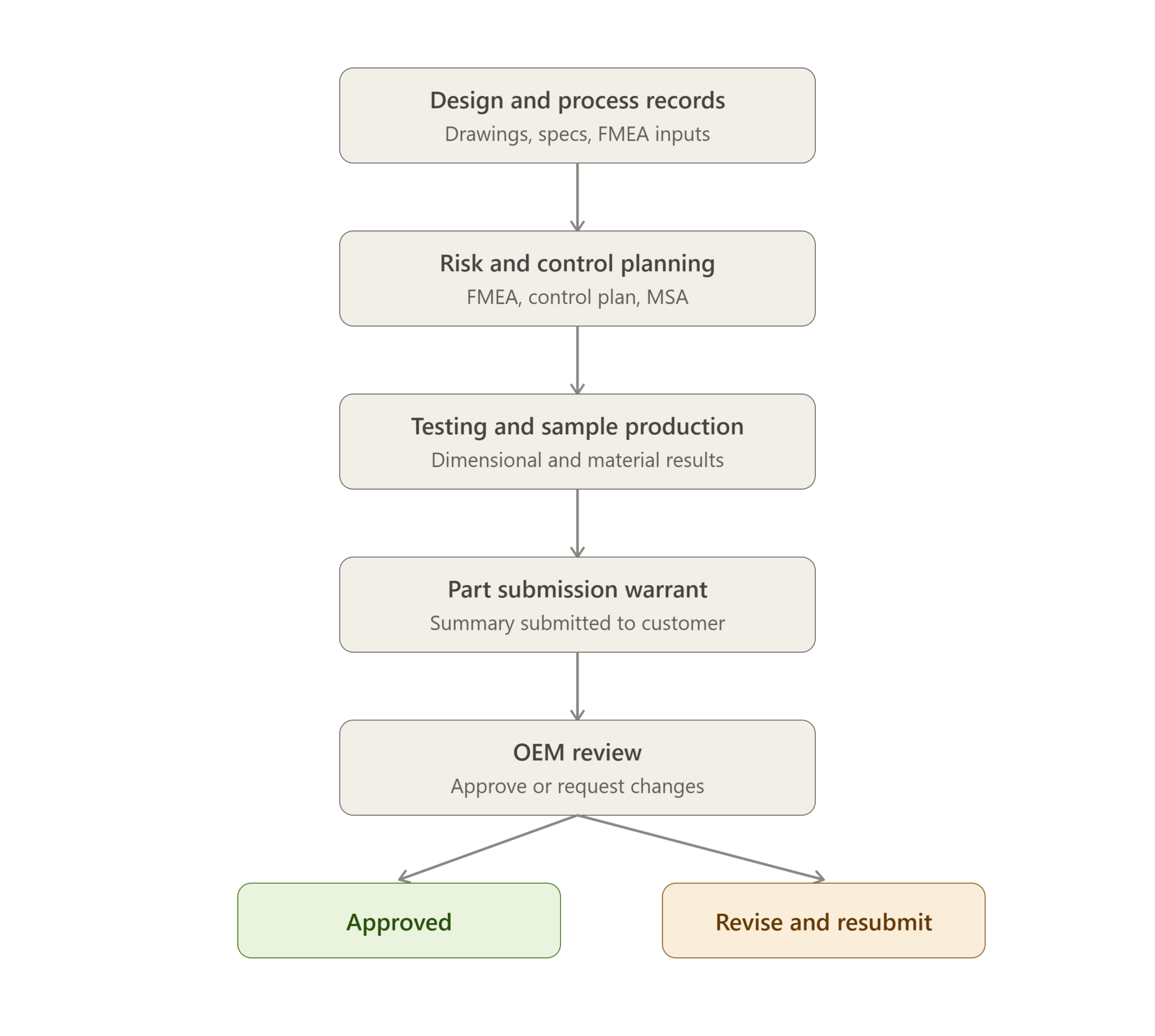
- Explore the Automotive ERP package built around quality processes like PPAP, CP, and CPK
- Explore the Foundry ERP package for dimensional and material capability tracking
- Take the ERP Tour to see quality management in action
- Talk to our sales team about your specific quality tracking needs
A process can look capable on paper and still be quietly producing defects in reality. Knowing the difference between CP and CPK — and tracking both continuously — is what closes that gap.
FAQ Section
What is the difference between CP and CPK?
CP measures a process’s potential capability, assuming it’s perfectly centered within specification limits. CPK measures the process’s actual capability, accounting for how centered it really is. CPK will always be equal to or lower than CP.
Which is more important, CP or CPK?
CPK is generally more important for quality audits and PPAP submissions because it reflects real production performance, including whether the process is centered. CP alone can be misleading if the process is running off-center.
What does a big gap between CP and CPK mean?
A large gap between CP and CPK indicates the process has good potential capability but is running off-center within the specification limits, which often means it’s producing more defects than the CP number alone would suggest.
What CPK value do automotive OEMs typically require?
Many automotive OEMs require a minimum CPK value, often 1.33 or higher, before approving a part for production, along with ongoing monitoring rather than a single measurement.
How does ERP software help track CP and CPK?
An ERP system with quality management built in can automatically calculate CP and CPK from production and measurement data, monitor trends continuously, and connect that data directly to PPAP documentation, reducing reliance on manual, after-the-fact calculations.

