

It’s Not a Software Problem—It’s an Operations Crisis
Walk onto the floor of any mid-sized custom manufacturing plant, and you’ll likely find a corner of the shop dedicated to an expensive tragedy: The Scrap Pile. If your facility lacks dedicated Engineering ERP software, this graveyard of perfectly machined, high-tolerance steel components becomes a costly, daily reality. It’s a mismatch between what design engineers build in CAD and what accounting thinks it needs to buy.
Imagine, At 9:00 AM, the sales team receives an urgent, high-stakes call from a key customer.
The question is simple: “Will our custom industrial filtration order be delivered by Friday afternoon?”
The salesperson immediately calls production. Production says the job is currently spinning on the shop floor. The planning department disagrees; they believe a critical, high-tolerance flange component is still pending custom machining. Meanwhile, the legacy inventory system reports enough stock, but the shop floor supervisor physically walks over to the bin and finds it completely empty.
To round out the chaos, purchasing is buried under a mountain of emails chasing suppliers, and upper management is demanding immediate, accurate answers for the client.
Sound familiar?
For many engineering and discrete manufacturing firms, this isn’t a rare, catastrophic incident. It is a stressful, daily reality.
As engineering businesses scale, so do the complexities of managing dynamic production schedules, fluctuating inventory, volatile procurement timelines, multi-tiered quality checks, and real-time machine utilization. When your core operational data is fragmented across isolated Excel spreadsheets, chaotic inbox threads, and disconnected accounting systems, even a simple customer update becomes an operational bottleneck.
This structural disconnect is the single biggest reason forward-thinking engineering companies are completely abandoning horizontal systems and migrating to industry-specific Engineering ERP software in 2026.
Why Does This Problem Happen? (The Legacy Creep)
Most engineering firms don’t start out in operational chaos. It develops gradually, almost invisibly, through a process we call “Legacy Creep.”
When the business is small, a simple spreadsheet is created to track raw material inventory. Another spreadsheet is spun up by engineering to manage assembly drawings. Purchase orders are handled via basic emails, quality records are written down on paper checklists, and finance operates in a completely separate, entry-level accounting app.
Initially, this patchwork system feels manageable. But as your order volumes scale, client design changes accelerate, and product bills of materials grow more complex, individual departments begin operating with entirely different versions of the truth.
-
The Production Team flies blind without real-time inventory visibility, scheduling jobs based on assumptions.
-
The Purchase Team reacts to component shortages after a machine goes down, rather than forecasting future material requirements.
-
Management is left driving the business looking through the rearview mirror, relying on week-old financial reports.
The root cause here isn’t poor employee performance or a lazy workforce. The issue is a fragmented data architecture. You are asking your team to execute precision engineering using disconnected tools that don’t speak the same language.
The Hidden Cost of Not Solving It
While visible issues like delayed deliveries or raw material stockouts are easy to spot, the true danger lies in the invisible financial leakage bleeding your balance sheet dry every month.
Consider a highly paid production planner spending three hours every single day manually updating, copy-pasting, and verifying Excel reports. Think about a procurement manager making dozens of frantic follow-up calls because supplier lead times and material certifications aren’t centralized. Picture a shop floor supervisor physically running between CNC machining departments just to check a project’s status because there is no digital tracking.
Combined, these manual workarounds swallow hundreds of high-value, productive hours every single month. This data friction manifests as severe, bottom-line hidden costs:
-
Extravagant Material Scrap & Rework: Manufacturing parts based on outdated drawing revisions because an Engineering Change Order (ECO) wasn’t pushed to the floor.
-
Blocked Working Capital: Hoarding excess “just-in-case” inventory because you don’t trust your system’s material planning accuracy.
-
Frequent Expediting Fees: Paying premium air-freight rates to ship missing components at the last minute to save a client relationship.
-
Severe Margin Erosion: Guesstimating your job costing and realizing a complex contract was unprofitable only after it has already shipped.
How Modern Engineering Companies Are Solving the Chaos
Successful engineering manufacturers are no longer patching up failing processes with more meetings or longer spreadsheets. Instead, they are implementing unified digital manufacturing strategies that tie every square inch of the business into a single source of truth.
By transitioning to an integrated digital thread, modern firms achieve:
-
Live Shop Floor Tracking: Capturing precise labor hours and machine cycles via digital kiosks right at the work centers.
-
Dynamic Material Planning: Synchronizing procurement directly with live production capacities and lead-time fluctuations.
-
Proactive Risk Mitigation: Utilizing predictive analytics to identify material bottlenecks weeks before they hit the shop floor.
The goal is simple: replace guesswork and reactive firefighting with clean, real-time operational data.
The Strategic Role of Engineering ERP Software
This is exactly where specialized Engineering ERP software becomes an indispensable growth engine. Unlike generic ERP platforms designed for simple distribution or retail models, a dedicated engineering ERP natively understands the complex workflows of Engineer-to-Order (ETO) and Make-to-Order (MTO) environments.
From the exact microsecond a customer blueprint is received to the final quality stamp before dispatch, the software anchors the entire operational timeline:
1. Advanced CAD & PLM Integration
Eliminate manual data entry entirely. Seamlessly bridge the gap between design and production by directly converting an Engineering Bill of Materials (EBOM) from software like SolidWorks or Autodesk directly into an actionable Manufacturing Bill of Materials (MBOM).
2. Precision Job Costing
Track the exact cost of every gram of material, every minute of labor, and every kilowatt of machine overhead against a specific project. Know your true margins in real-time, not weeks later.
3. Dynamic Material Requirements Planning (MRP)
Automate your procurement cycles. The system looks at your active designs, cross-references current inventory balances, evaluates supplier lead times, and tells you exactly what to buy, when to buy it, and where it needs to be delivered.
4. Closed-Loop Quality & Compliance
Embed strict inspection checkpoints directly into the production sequence. Track material test reports (MTRs), serial numbers, and compliance metrics effortlessly to eliminate defects before they leave your facility.
Real-World Transformation: From Chaos to Control
Consider the case of a mid-sized precision engineering firm specializing in custom heavy-machinery components. A long-standing client suddenly submits an emergency request to increase an active order quantity by 25%, while simultaneously updating a critical structural tolerance on the blueprint.
Without an Engineering ERP: Management would need to halt production, call an emergency meeting, and spend hours—if not days—manually cross-referencing raw steel stock, checking CNC machine availability, calculating workforce capacity, and emailing updated PDFs to the floor. The risk of manufacturing the old design remains dangerously high.
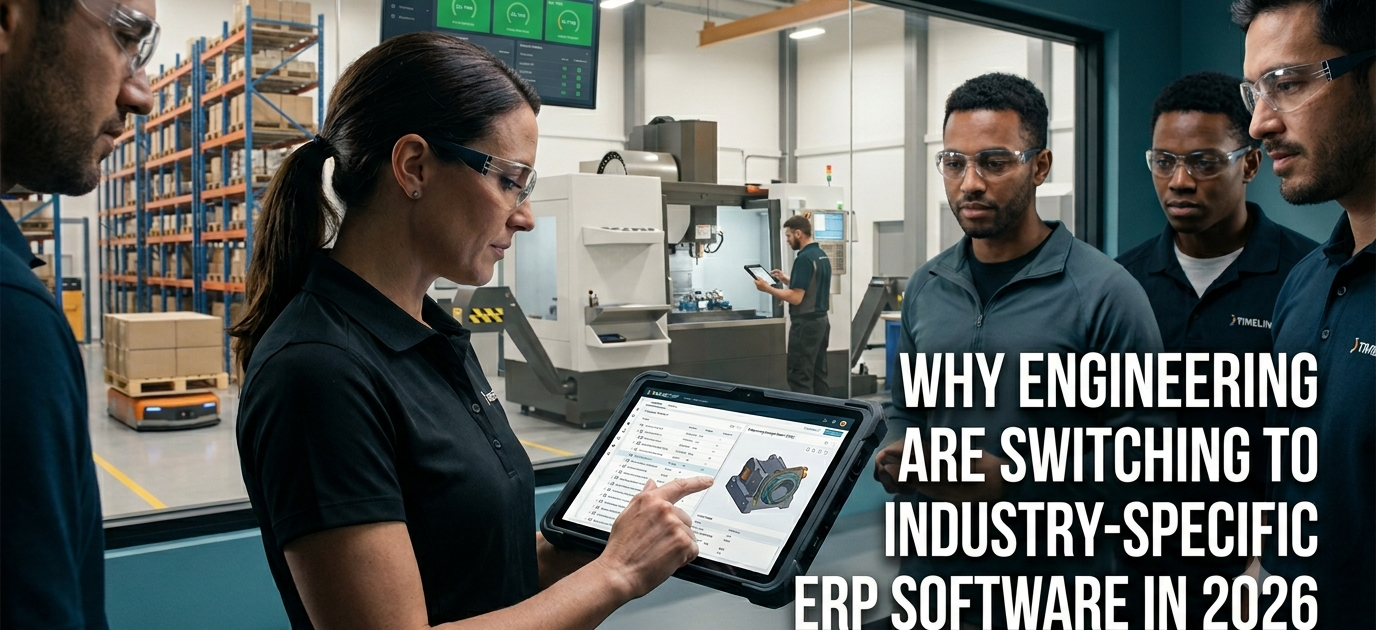
With an Engineering ERP: The moment the design change is updated, the system evaluates active capacity across all work centers. It automatically identifies the material shortfall, triggers optimized purchase orders for the extra raw steel, routes the updated CAD revision directly to the operators’ tablets on the shop floor, and recalculates the revised project margin instantly.
The company responds to the client with confidence in minutes, turning a chaotic disruption into a highly profitable upsell.
Future Manufacturing Trends Driving ERP Adoption in 2026
The engineering landscape has entered an era of rapid digital evolution. To remain competitive, manufacturers are facing intense pressure to produce complex parts faster, minimize their environmental footprint, and maintain zero-defect quality.
Several major macroeconomic trends are accelerating the shift toward engineering-focused ERP platforms this year:
-
AI-Powered Production Scheduling: 2026 ERP platforms feature built-in machine learning algorithms that analyze historical production run rates to autonomously optimize scheduling sequences, minimizing machine setup times and idle labor.
-
IoT Industrial Integration: The lines between software and hardware have blurred. Modern ERPs hook directly into smart shop floor machinery via IoT protocols, pulling live performance analytics, tool wear tracking, and predictive maintenance alerts directly into the management dashboard.
-
Supply Chain Transparency: With global logistics remaining highly volatile, businesses are leveraging cloud-native ERP networks to collaborate with suppliers in real-time, gaining end-to-end visibility into material shipments.
Signs Your Engineering Company Has Outgrown Spreadsheets
Is your business structurally ready to scale, or is it held together by fragile manual processes? If your facility experiences any of these warning signs, your business has officially outgrown manual workflows:
-
You face frequent production delays because of missing, unordered minor components.
-
Your physical inventory counts rarely match what is listed on your office spreadsheets.
-
Different departments are arguing over whose data version is actually correct.
-
It takes days of stressful spreadsheet manipulation to prepare a high-level management report.
-
Outdated drawing revisions are accidentally making their way onto the manufacturing floor.
-
You are struggling to pinpoint the exact profitability of individual custom jobs.
Conclusion: The New Standard of Engineering Profitability
Transitioning to an industry-specific ERP is no longer a luxury for IT modernization—it is a core strategic decision that dictates market survival.
Running a high-precision engineering company on basic spreadsheets or generic accounting software is the equivalent of trying to build an aerospace asset with a hammer and a hand-saw. Your engineers design with microscopic precision; your operational software must execute with that exact same level of accuracy.
In 2026, the most successful engineering companies won’t necessarily be the ones with the largest facilities. They will be the agile, data-driven organizations that possess absolute visibility into their operations, empowering them to make smarter decisions faster than the competition.

