
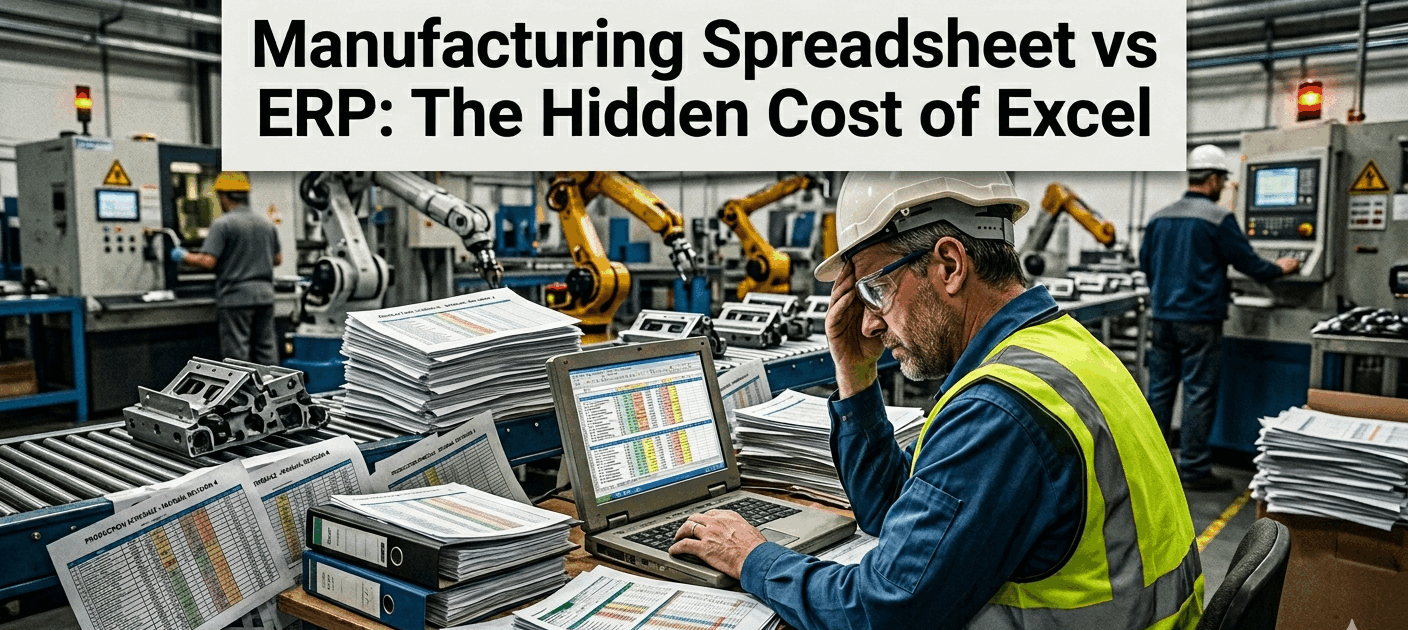

When evaluating a manufacturing spreadsheet vs erp platform, it is easy to see why small shops start with Excel. Every custom manufacturing spreadsheet has a creator—usually a brilliant plant manager or senior scheduler who stayed up late one night stitching together a labyrinth of formulas, conditional formatting, and custom macros. It represents complete control. It is flexible, free, and intimately understood by the person who built it. But as a manufacturing facility grows, that control turns into chaos.
The Hidden Reality of a Manufacturing Spreadsheet vs ERP
When you ask a team how long it takes to build the weekly production schedule, they might say, “Oh, about an hour.”
But they aren’t counting the hidden hours spent fixing broken cell references because someone accidentally dragged and dropped a column. In the debate of running a manufacturing spreadsheet vs erp system, the invisible tax of manual data entry is staggering. Over 88% of complex spreadsheets contain human errors.
The moment an operator calls in sick, a critical raw material shipment gets delayed, or a packaging machine goes down, a static sheet shatters. To fix it, someone has to open the file, manually adjust cells, save it as Production_Schedule_v5_FINAL.xlsx, and email it out again.
“Good Enough” Becomes a Strategic Ceiling
Relying on local workbooks creates a subtle operational trap: it forces an organization to operate entirely on lagging indicators.
You find out a specific line suffered a major bottleneck not while it was happening, but during the Friday afternoon recap. You realize a team spent three hours idle due to a material shortage only after the shift variance report is generated.
Operating this way means always playing catch-up. It turns highly skilled operations leaders into full-time firefighters instead of strategic planners.
When your data lives in isolated desktop silos, the gap between a real-world disruption and a managerial decision can span hours or even days.
Breaking Down a Manufacturing Spreadsheet vs ERP System
To remain competitive, modern plants must shift from static forecasts to dynamic, data-driven decision-making. To see how these methods stack up directly, you can refer to established international manufacturing data structures provided by standard data governance groups like the ISO Quality Management Standards to evaluate structural compliance.
| Operational Feature | Manual Spreadsheets (Excel) | Modern Manufacturing ERP |
| Data Refresh Speed | Lagging (requires manual input) | Real-time (via shop floor IoT integration) |
| Information Architecture | Isolated Data Silos | Single Source of Truth |
| Workload Balancing | Reactive (after a bottleneck occurs) | Predictive (identifies line capacity issues early) |
| Inventory Control | Prone to human tracking errors | Automated reorder points and full visibility |
What Follows the Spreadsheet?
Moving away from a beloved spreadsheet system can feel incredibly intimidating. No one wants to exchange a tool they completely control for a rigid, overly complex enterprise system that requires months of disruptive training.
But modern infrastructure has evolved beyond the monolithic, inflexible ERP installations of the past.
Transitioning to an integrated platform isn’t about changing how you make your products; it’s about giving your team a clean window to see exactly what is happening across your facility in real time.
Imagine a morning where:
-
The Floor Updates Itself: Material consumption and machine outputs feed directly into a centralized dashboard, completely removing manual data entry errors.
-
Workloads Balance Hydraulically: If a bottleneck forms on Line 2, your scheduling platform highlights the exact labor capacity available on Line 4 to absorb the pressure before a delay occurs.
-
One Version of Truth Exists: The front office, the warehouse, and the floor operators are all working off identical, real-time insights—no duplicates, no outdated files, no confusion.
Giving Your Team Their Time Back
The true value of modern software isn’t just about tracking inventory numbers or calculating machine metrics; it’s about reclaiming human capacity.
Every hour your smartest engineers and supervisors spend manipulating cell formulas or chasing down missing data fields is an hour they aren’t spent optimizing line layouts, training new operators, or improving product quality.
The spreadsheets served your operation well when your business was trying to survive its early growth. But to scale effectively in an unpredictable market, your shop floor needs an operational framework built for agility, clarity, and peace of mind.
Choosing a Winning Solution: Manufacturing Spreadsheet vs ERP
There is no shame in admitting that your facility still runs on Excel. It is a testament to your team’s ingenuity that you’ve pushed static files this far.
However, a manual manufacturing spreadsheet vs erp setup has a distinct ceiling. Transitioning from local workbooks to a centralized ecosystem isn’t about replacing human intuition on the shop floor—it’s about empowering it. By giving your team a single source of real-time truth, you stop managing data anomalies and start managing your efficiency.
If you are ready to see what your shop floor looks like without the data blind spots, explore the TimeLine ERP Production Scheduling Module or connect with one of our manufacturing specialists for an informal, no-pressure Live System Walkthrough.

