
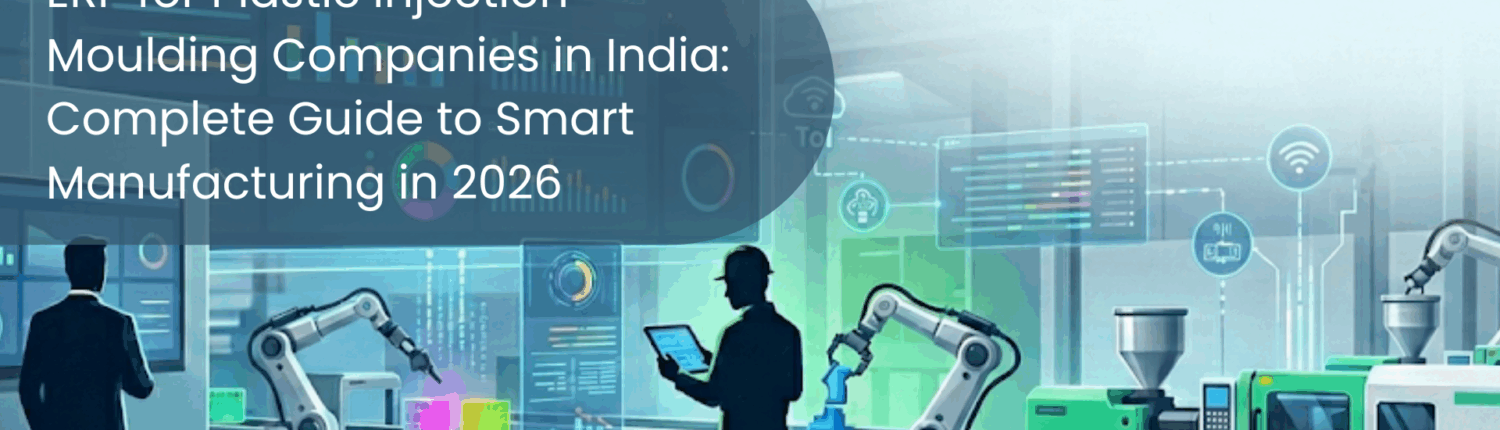
ERP for Plastic Injection Moulding: Why India’s Plastic Manufacturers Are Embracing Digital Transformation
Walk into any plastic injection moulding factory today, and you’ll see a familiar scene—machines running continuously, operators monitoring production, supervisors chasing delivery schedules, and managers trying to balance costs, quality, and customer expectations.
At first glance, everything appears to be under control.
But behind the scenes, many manufacturers are fighting a constant battle against production delays, raw material shortages, machine downtime, quality issues, and rising operational costs.
The Indian plastic industry has grown rapidly over the last decade. From automotive components and consumer products to packaging materials and medical equipment, plastic injection moulding has become a critical part of the manufacturing ecosystem. However, as customer expectations increase and competition intensifies, traditional methods of managing operations are no longer enough.
This is where ERP for Plastic Injection Moulding is making a significant impact.
Today, forward-thinking manufacturers are replacing spreadsheets, manual registers, and disconnected software systems with intelligent ERP platforms that provide complete visibility across their operations.
The Reality of Managing a Plastic Injection Moulding Business
Consider a common situation.
A customer places an urgent order that needs to be delivered within ten days. The sales team confirms the order, but soon questions begin to emerge.
- Is the required raw material available?
- Which machine has production capacity?
- Is the mold ready for production?
- Can the delivery timeline actually be met?
Without a centralized system, finding answers often means multiple phone calls, spreadsheets, and manual checks. Valuable production time is lost, and decisions are made using outdated information.
Now multiply this challenge across dozens of customer orders, multiple production lines, hundreds of inventory items, and strict delivery commitments.
The result is often confusion, delays, and unnecessary costs.
This is precisely why manufacturers are investing in Plastic ERP Software.
Why Traditional Systems Are Holding Manufacturers Back
Many plastic manufacturers still rely on separate systems for inventory, accounting, production planning, and quality management.
The problem isn’t a lack of effort. The problem is a lack of visibility.
When departments operate independently, information becomes fragmented.
Production doesn’t know current inventory levels.
Inventory doesn’t know future production requirements.
Management doesn’t have real-time performance data.
Quality issues are discovered too late.
As a result, companies struggle with:
- Excess inventory and blocked capital
- Frequent material shortages
- Production bottlenecks
- Higher rejection rates
- Delayed customer deliveries
- Reduced profitability
In an industry where margins are constantly under pressure, these inefficiencies can significantly impact business growth.
How ERP Changes the Game
Imagine having complete visibility into every aspect of your manufacturing operation from a single dashboard.
The moment a sales order is received, the ERP system automatically checks inventory, evaluates production capacity, calculates material requirements, and generates a realistic production schedule.
Instead of reacting to problems, manufacturers can prevent them before they occur.
This shift from reactive management to proactive decision-making is one of the biggest advantages of ERP for Plastic Manufacturing.
Better Production Planning
Production planning is often one of the most challenging aspects of injection moulding operations.
A delayed mold, unavailable machine, or missing raw material can disrupt the entire schedule.
ERP software helps manufacturers create realistic production plans based on actual capacity and resource availability.
This means fewer surprises, smoother operations, and improved on-time delivery performance.
Smarter Inventory Management
Raw materials represent a major cost for plastic manufacturers.
Without accurate inventory tracking, businesses frequently overstock materials they don’t need while running out of materials they do need.
ERP systems provide real-time inventory visibility, helping companies maintain the right stock levels while reducing waste and carrying costs.
Improved Machine Utilization
Injection moulding machines are valuable assets.
Every hour of downtime affects productivity and profitability.
Modern ERP solutions can capture machine performance data, helping manufacturers monitor utilization rates, identify bottlenecks, and schedule preventive maintenance more effectively.
Instead of waiting for machines to fail, businesses can take action before problems occur.
The Growing Importance of Quality Control
Customers today expect more than just competitive pricing.
They demand consistency, traceability, and reliability.
Whether supplying automotive components, packaging products, or medical devices, manufacturers must demonstrate that quality standards are being maintained throughout the production process.
ERP systems help achieve this by recording inspection results, tracking non-conformances, managing corrective actions, and maintaining complete production histories.
This level of traceability not only improves customer confidence but also supports compliance with industry standards.
The Future Belongs to Smart Manufacturers
The manufacturing landscape is changing rapidly.
Technologies such as Industry 4.0, Artificial Intelligence, IoT-enabled machinery, and real-time analytics are reshaping how factories operate.
ERP acts as the foundation that connects these technologies together.
Manufacturers who invest in digital transformation today are positioning themselves for future growth, greater efficiency, and stronger competitiveness.
Those who continue relying on manual systems may find it increasingly difficult to keep pace with industry demands.
The Ministry of Commerce & Industry plays a significant role in shaping India’s manufacturing ecosystem through policy initiatives, trade regulations, and industrial development programs.
Final Thoughts
The plastic injection moulding industry is evolving, and successful manufacturers are evolving with it.
ERP is no longer viewed as a luxury reserved for large enterprises. It has become an essential business tool for manufacturers seeking better control, improved efficiency, and sustainable growth.
For companies looking to reduce waste, optimize production, improve customer satisfaction, and prepare for the future, ERP for Plastic Injection Moulding provides a clear path forward.
The question is no longer whether manufacturers should adopt ERP.
The real question is how much longer they can afford to operate without it.

